Sunday, March 13, 2011
Home Gardening Update 3.13.11

I just thought I'd post a little update on the container garden I started wayyy back in November. November was too late to be starting these things so most everything didn't do very well and didn't grow much at all over the winter, but now that it's getting toward spring things are really ramping up their growth.

My broccolil and cauliflower both died except for this one tiny little broccoli plant in the middle of this pic that is hanging on to life but not growing very large at all.

The big frilly green leaves are carrots which are getting almost big enough to harvest.
On the left and in the front is lettuce but neither of those ever did well and the one on the left is bolting so I'm just going to let it.


Here's another pot full of carrots, plus some bolting salad greens of some kind in the center. I'm not sure what exactly it is because I got it from the community garden without knowing what it was.

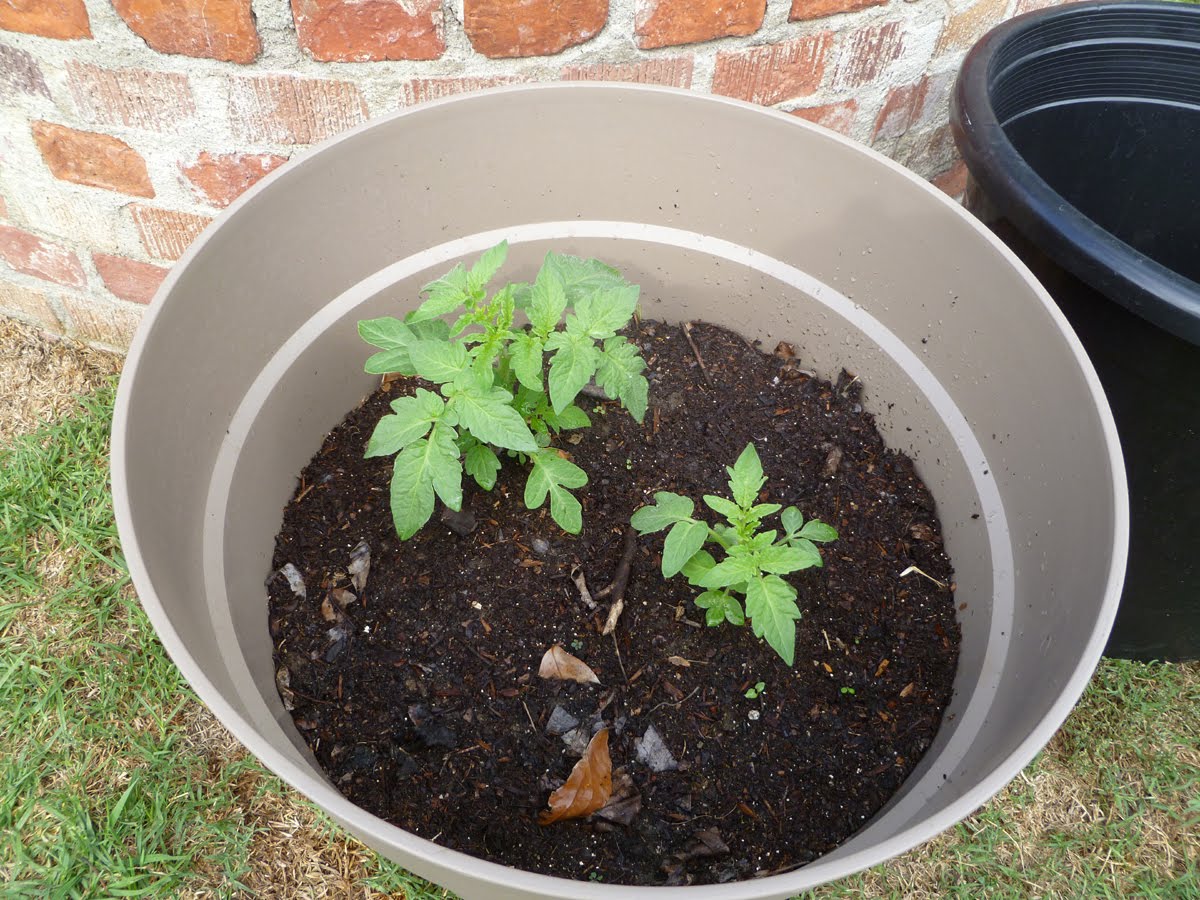
Here we have my Bush Goliath tomatoes, which at first glance don't look very good but... when you look closer you see a ton of little tomatoes popping up all over the place!


Next up is what used to be some perpetually tiny bell pepper plants. My theory is that the container I had them in was not deep enough for their root system so they stayed tiny and feeble. They WERE alive however, until aphids infested damn-near all of my plants. I acted swiftly with a self-made non-toxic pesticide and everything else was fine after that but these guys were really badly injured, so much so that I'm not sure if they'll ever come back.

I did take one however and use it as an experiment to resuscitate it. I've got it under an overturned fish-tank which should work as a mini-greenhouse. I've given it root-growth supplement and compost and have a grow-light on top to keep it nice and warm when the sun doesn't do a good enough job of that.

It's like a baby in an incubator :'(

These are my Spanish Yellow Onions. They took a long time to do anything as well, staying small throughout the winter but now they're starting to grow. Still not near big enough to harvest though.

Over here around this broken pond I'm going to grow from left to right: Mint, Dandelion greens, strawberry, and chamomile. In this pic the seeds have been spread and watered. The power extension cable you see is for the grow light for the incubator-bell-pepper. The branch tossed on the mulched bed on the right is to keep my dog from pooing on my mulched bed.

And lastly on this side I've broken up & aerated the soil but haven't planted anything yet or even decided what to plant. Probably some kind of flowers that have an herbal medicinal use.

By the way if I didn't mention it last time, the reason I have a lot of things in containers and nothing in the ground yet is because I rent and last year I was worried about tearing up the ground of a property I don't own, but this year IDGAF. If they don't like it I'll tear it out when I move, but honestly it's going to look nice and be useful for food and herbal medicine so they shouldn't complain.

Saturday, March 12, 2011

Soil Cube Seed Starting.

In addition to going to the community garden today, I started some seeds for my own home garden since the seeds I ordered finally came in. I wanted to start earlier but the seeds took some time to get to me. Oh well. NBD.

First of all here is what I got (all from reimerseeds.com)

  • UC 157 Asparagus
  • White Spear Onions (bunching onions)
  • Mountain Mint
  • Wando Sweet Peas
  • Alexandria Strawberries
  • Dwarf Greek Basil
  • Dandelion
  • Roman Chamomile
  • Valerian
This was the first time I was able to use a new seed-starter tool that I got called the Soil Cube Tool. This is one of many little tools that compact soil into a little cube for starting seeds in, rather than using a plastic or peat seed-starting trays.

Plastic starting trays and cups are problematic in that the roots tend to hit the plastic and then start circling in a tangled clump inside the container, then when you plant that, the roots can still continue this root growth that has been "trained" by having it in the plastic pot and it can end up getting choked up in it's own roots. The way to help prevent this is to physically tease the roots out before planting, but that can cause damage and either way you're going to get some root-shock which means a delay in growth.

Peat is supposed to be nice because it's biodegradeable and you can supposedly just put the whole thing in the ground and the roots will grow out through the peat as it decomposes. Truthfully though, this can have the same problem as the plastic in inadvertently training the roots to grow in a compact tangled clump and frankly, I haven't found the peat pots to decompose all that well anyway.

Soil cubes or blocks differ in that there is no container whatsoever, the soil is the container. Since there is no edge to the "container" the roots will simply stop growing when the hit the edge. Plants roots have their own intelligence that will keep them from popping roots out of the sides of the soil cube. Instead, it will make the root system a bit more robust within the cube which serves to hold the cube together when it's in that form and when placed into the ground will just take right off and grow out into the soil, eliminating root shock. As for watering, you just water lightly, but the compaction and the fact that the roots hold it all together make the whole cube pretty decently held together.

FYI: Though the tool may be modern, the method is nothing new. The Aztecs did something similar way back int he day.

Here is the Soil Cube tool. It is made up of two square pieces of (PVC?) plastic with a handle and a spring press. You fill the plastic compartments with the soil mixture, place it on a flat surface, and press down firmly to compact the soil within the compartments. You then lift up the tool and press down again to slide the compacted soil cubes out of the chambers.

Above is the soil mixture I used. They recomend the following soil mix recipe:
  • 3 parts peat moss
  • 2 sand and perlite mixed
  • 1 part garden soil
  • 2 parts compost
  • a touch of lime and fertilizer
I used some of those ingredients, but did not measure parts at all. I just threw it in there, mixed it up and got it wet to an oatmeal consistency as recommended.

Here is what the soil cubes look like when they come out of the tool. Built into the tool is a couple of nuts which create little depressions, all set for putting the seeds in. They're not very deep though so for some seeds you may have to take a stick and make them bigger.

Anyway, you plant your seeds, cover with more soil and use some included wooden tongs to place them in your seed tray. I use my own grow-light system made from a plastic storage bin.

They almost look like brownies or something huh? lol. The ones in the middle are strawberries, which it is recommended to just very lightly cover with peat rather than "bury".

Friday, February 25, 2011

Link: Organic Lawn Care For the CHEAP and LAZY! :)

Great article by Paul Wheaton, permaculture expert enthusiast extraordinaire!
Lawn care simplified. Have the best looking lawn on your block with less mowing, less watering and less money. The cheapest lawn care AND the laziest lawn care.

Make sure to check it out :)

http://www.richsoil.com/lawn-care.jsp

Tuesday, February 22, 2011

New Gear: "SaberCut" Pocket Chain Saw

Another new bit of gear I got is a "SaberCut" pocket chain saw.

It's a 24 inch chain with bi-directional teeth built-in and flat nylon handles on each end. You wrap the chain around the thing you want to cut and pull back and forth to cut it. It comes in a nylon pouch with a belt loop and a buckle closure. The pouch feels a little flimsy but it's not as if some super sturdy pouch is really required for an item like this so it does the job just fine. I should also mention the slight detractor that the nylon handles can sort of hurt your hands if you're pulling really hard, but if you've got some climbing or gardening gloves to give your hands a little extra padding that helps.

I keep mine strapped to the bottom of my right-side backpack strap to have it easily available whenever I need it. So far I've used it on a very annoying woody vining plant in my backyard (approx. 2in diameter) as well as long fallen branch on a hiking trail that I frequent (approx 3in diameter) and both times it worked just fine for my purposes. The saw teeth can bind every once in a while if you're holding the two ends very narrowly though so I'd say it's best to hold them nice and wide for best results.

Overall, it's not a bad item if you need a compact cutting tool, not the best either but does what it's supposed to.

Total weight of case and saw together is 6 ounces.

I got mine at a slight discount for a little under 25$ US at SawTac.com

Monday, February 21, 2011

New Gear: Maxpedition Volta™ Battery Case

So another new piece of gear I've acquired is case to store spare batteries for my headlamp and flashlight. The Maxpedition Volta™ Battery Case is a 1000-denier nylon pouch with a velcro flap closure which attaches to a pack via MOLLE webbing.
Can I just take a pause for a second to say that I love MOLLE webbing? I don't understand why nothing non-military makes use of it's capability to securely attach extra accessories to a backpack. It seems like something that should be more widely used among general hiking and camping gear because there really are a lot of cool little add-on things you can use it for.
Anyway, inside the pouch comes a plastic case which can hold up to 8 batteries of size AA, AAA or CR123. (Apparently if one were so inclined it could also hold 5 shotgun rounds, or even a cell phone or iPod. I actually did put my phone in there once while hiking). The plastic case itself is actually two parts which can be detached from each other. I think I heard it described that some folks use the two sides for "new" and "spent" to keep track, but I don't use that method. I keep it full and just hope I can figure out which ones are spent. I've only had to change a battery out once so far so it hasn't been an issue yet.
I keep 4 spare AAA batteries in one side for my Petzl headlamp and 4 CR123 batteries on the other side for my little Leatherman LED flashlight.
The nylon pouch seems well built, the plastic case is not bad either. It does feel like the two halves of the case come apart rather easily, but if they're in their proper place inside the nylon pouch that won't be any kind of an issue anyway.

Some additional info: There's also a small grommet hole at the bottom of the nylon pouch for water drainage. I'm not sure if the plastic cases are watertight but I'd imagine they'd hold up okay for a short amount of time .
The velcro (or "hook & loop" since I think "velcro" is a specific brand) closure seems to stick out a bit, but it's secure enough.
Also the plastic case fits very snugly inside the pouch. You have to push it out from the bottom side of the nylon pouch to get it out so I'd say it's pretty secure.

I think it ran me about 15$US and I'm comfortable enough with that considering it doesn't feel like something I'm going to have to replace anytime soon.

Sunday, February 20, 2011

New Gear: Original S.O.E. Gear Tear-off IFAK

I've been in a mood to re-assess my preps lately and add to them and one thing I bought recently was a new medical pouch to mount on the outside of my backpack. This is my new "Original S.O.E. Gear" brand "Tear-off IFAK" medical pouch.
It consists of a panel that attaches right to my hiking backpack via MOLLE webbing, as well as a separate pouch that velcros on to the panel and is further held in place by buckled retention straps.
The benefit of having all of my first-aid stuff on the outside of my pack is that if I need it I can easily unbuckle the retention strap, grab it by the red handle (which denotes medical) and tear it away from the velcro backing to quickly retrieve everything at once and have it in an organized manner, rather than wasting time digging through my bags to find loose items. It also frees up room inside my bag so it's not so jam packed in there.

As for the contents and storage features, let's start on the outside.
On the outside is a small flat-ish pocket which can be held closed with the velcro that lines the edge. Inside of this pouch I keep a small waterproof pouch which used to be a "pocket medic" kit but I used up most of the contents. you can see this peeking out of the pocket in the image above, or in the bottom-right corner in the image below. Inside of this pouch I keep:
  • a multitude of different sized bandaids
  • disinfectant wipes
  • some tweezers and safety pins that came with the original med-kit.
The inside opens fully in a clamshell design for easy access to all of the contents. Even though my purposes are only basic first-aid and convenience items for hiking and camping, it's still really nice to have everything organized and easy to access.

The top half has three different sized sets of elastic straps, one large pouch, and one small pouch. In this area I keep:
  • Sunblock
  • Bug repellent spray
  • ibuprofen (pain relief)
  • generic benadryl (allergy relief)
  • hydrocortisone cream (itch relief)
  • triple anti-biotic ointment
  • hand-sanitizer
On the lower half is one large set of elastic bands and a big zippered mesh pocket. I haven't come up with anything to use keep in the large elastic bands yet, but in the mesh pocket I keep:
  • two 4x4 sterile gauze pads
  • two 3x4 non-adherent bandage pads
  • one set of assorted moleskin blister pads
  • bite & sting kit (a suction kit for such wounds)
A couple of things missing right now that I plan to include are some ace-wrap bandages (such as to wrap a sprained ankle), and some medical tape.

All in all I'm very pleased by the quality of workmanship that goes into Original S.O.E. products. I have no doubt this thing will serve me well on my camping and hiking this coming summer and will be something that will likely outlast me in it's usefulness.

Sunday, November 14, 2010

New Gear: Snow Peak Mini Solo Titanium Cook Set

A quick bit about a piece of gear I've purchased and used. I'm going to be periodically posting a lot of these in the near future.
This time it's the Snow Peak brand Mini Solo Titanium Cook Set.

This consists of a small titanium pot with a lid and a titanium cup, both of which fit together for storage, and the two pieces come in a mesh bag to hold them together. Each container has folding handles.
I got to use these items, or at least the cup, on a weekend survival training retreat that I took a couple months ago. We found and picked wild elderberry leaves and wild mint and made tea with them and though we used a different titanium pot to boil the water in, I did use my own cup to drink the tea and I have no complaints. The tea itself was ABSOLUTELY DELICIOUS by the way :) Best I've ever had.

In order to maximize the use of space, I also keep some small supplies inside my titanium pot. Inside I keep a 7ft length of twine, an easy-sharpening tool for my blades, a 25ft length of 550 paracord, and two cliff-bars.

Sunday, November 7, 2010

Home container garden update

I don't know if this is really an update as I never posted the initial stuff on here, just on my social networking account, but I wanted to post my progress here since I've got multiple images to share.
Today I bought some more containers and potting soil to add to what I'm already growing.

I've tried to start from seed the following vegetables for a fall container garden:
- Carrots*
- Lettuce
- Broccoli
- Cauliflower
- Yellow Onions*
- Bell Peppers*
- Tomatoes*

Those with asterisks* were planted a few weeks ago, but the other three were still sitting in their biodegradable seed trays, drying out and running out of space to grow, and therefore dying. I finally decided to try and save them and bought some containers, rocks for dainage, and potting soil.


This here is the mess I made getting everything done today.
There are two large black containers with Broccoli, Caulifower and Lettuce in them, a small black container with mixed salad greens (which I ate for lunch just before posting this), two long containers with bell peppers and onions, respectively, wich you can't really see behind two are two old fish/reptile tanks which I plan on using as mobile mini-greenhouses if I ever have a large enough space to do so.


I'll spare the images of the broccoli, cauliflower and lettuce plants as they're so tiny and non-green that they barely stand out in front of the potting soil, but here's a picture of the 7/8 carrots I planted. One definitely didn't make it so it's just 7 now. By the way, growing in an old kitty-litter container.


Here above are the bell peppers and below are the Spanish Yellow onions.

I was thinking of growing green onions as well, we use them a lot in our boiled chicken for enchiladas and tacos and whatnot, but I just didn't get around to ordering any seeds so just yellow round onions for now. They'll be good to cut up and put in the rice or ground beef.


Despite the fact that tomatoes are supposed to be a warm-weather crop, mine are doing, very well, better in fact that anything else if the health and size of the leaves are to be any indicator. Thanks to our warm southern california weather, these babies seem pretty happy, even though it's admittedly been getting a bit cold and rainy lately.

They're actually a hybrid bush variety called "Bush Goliath," recommended by Jack Spirko of The Survival Podcast which I listen to on a regular basis. They're supposed to be better for container gardening because they grow in a bush rather than vine all over the place and they grow really nice big tomatoes, great for putting on sandwiches and burgers, which is what I tend to use tomatoes for more often than anything else.
Motivated by the success of this so far, I'm planning to grow some other varieties of tomatoes next spring/summer. Varieties better for putting in salads and making into sauce and paste so I can try and make my very own spaghetti sauce, sloppy joe sauce, and whatever else I can think to do with my own organic tomatoes.


Here's the aftermath of the salad I had for lunch. It used to be much bigger (it's actually three separate plants), but this is what it looks like after I've cut most of it off for my salad. It should grow back about 4-5 times before it stops so I've got some more tasty organic self-grown salad ahead of me.
I actually got these salad greens from the community garden I volunteer at.


This here is the remnants of my broccoli, cauliflower and lettuce. I took the best three of each and planted them in larger containers, but these look like they're done for. Either way though, I noticed that the clovers beneath my overturned fish/reptile tanks were growing pretty strong so I decided to water these dead looking guys and stick them underneath to see if I can possibly save them. Fingers crossed.
*******************************
I really would like to plant in the ground, put in raised beds, and do WAY more than this, but as I'm renting all I can do is stick to container gardening. This is good though. I'm learning that I really have to be more attentive to my plants if I want them to do well. I'm lucky I've got as much still healthy as I do have, considering I sort of neglected them quite often as far as watering and I took WAY too long to finally plant these things. Lucky for me I live in one of the most forgiving climates in the country here in southern California and the city I'm in was originally all agricultural land (and much of it still is).

Anyway, just wanted to post about my progress, for my own sake as much as for the interest of anybody else who might care. I'm very happy to be progressing toward my goal of learning to self-sufficiently grow my own food and I'm taking note of every lesson I learn in the process.

Monday, July 5, 2010

Gerber Gator Jr. Machete

So one of the items I recently picked up is the Gerber Gator Jr. Machete. It's a 10" blade and it has a saw blade edge on the back.
I must say that I absolutely love this thing. It's leaps and bounds better than the cheapy 18" one I got from Harbor Freight in terms of weight balance, hand comfort and overall sharpness and chopping power.
The saw blade works very well and the ability to have both in the same tool is really convenient and made chopping up a monster vining bush in my yard into simple work.
The sheath this thing comes with is great too. it's got some rigidity to it and feels durable. The only thing I wish the case had is more capability to attach it to my backpack instead of just the standard belt loop.
This is the "Jr." 10-inch blade model, versus the standard 17-inch blade size. I went with this because I think it's a lot more versatile and easier to swing around. I was able to get into tight places on the bush I hacked down where an extra 7 inches would have made it impossible. The shorter size also makes it much more convenient for me to keep in or on my backpack. While I'm sure the extra weight at the end of the full-sized model would be great for a bit more chopping power, this one has enough weight to it for it's size and it's well balanced enough that it certainly gets the job done very well regardless.
Anyway this thing is great for yard work and I plan on taking it with me the next time I go hiking because there are some fallen branches on the trail I frequent that could use some clearing if someone hasn't got to it first. Also, it comes very nice and sharp but I haven't had to do any sharpening myself yet so I'm not sure how easy that will be. I'm a total novice so well see how that goes when the time comes that it needs it.

Friday, June 4, 2010

New Camelbak hydration pack. I'm stoked!

So I've been hiking a lot more lately and unhappily using my little brother's old "Outdoor Products" hydration pack. The thing was flimsy, not very well made and felt like it did a really bad job of distributing the weight on my back, so I decided to invest (somewhat heftily) in a Camelbak hydration pack.

I went with the Camelbak H.A.W.G 500 (don't ask me what h.a.w.g. stands for). It's the second iteration of the H.A.W.G. and the "500" comes from the fact that it's made from 500 denier cordura nylon material, which is half the denier rating of the original's 1000 denier (which is what the best military equipment manufacturers use). Denier is a rating for strength in cloth products.

The 500D makes it lighter, which is great by me, and I don't really need something to be a full 1000D for my purposes anyway. The 500D material feels PLENTY tough in it's own right and loads tougher than whatever the hell the last pack was made of.

Having never owned or experienced a real Camelbak pack, I was a little wary of spending $125 on a hydration pack, but after getting this thing I'm a firm believer in the brand and the quality they put into their products.

This is actually from Camelbak's military line and I wanted it because I knew it should be made to last and the PALS webbing on it will be ideal for mounting a tear-away velcro first-aid kit (makes no sense to have to take extra time to dig into my pack if I or someone else get's injured.)

Anyway my pack is shown up there sitting happily with my 1-liter Camelbak water bottle and my Leatherman Wave.

Here's the product page for all the details:
http://www.camelbak.com/government-military/hydration-packs/hawg-500.aspx

Sunday, April 18, 2010

Not forgotten

I haven't completely forgotten about this blog, but I do constantly forget to post to it.
Since my last post I've stored some food in sealed mylar and food buckets. I can proudly say that if I were to lose my source of income I wouldn't have to worry about going hungry for a full month.
I've also purchased a firearm. A Remington 870 Express 12ga shotgun. I can now proudly say that I am supporting the inalienable and human right our nation recognizes of an individual to possess the means to both defend and provide for himself and those he loves.
I've also been doing more hiking and getting myself in better shape.
I've also found myself an awesome girl who is of like mind as far as having a goal of a self-sustaining lifestyle. Very stoked about that, hope it continues to go well.
I've also purchased various things for an emergency kit to keep in my car. With all these earthquakes happening lately you can't knock wanting to at least be prepared in case a big one hit our part of California.

I probably will continue to forget to post here, but I'll stop in as often as I remember.

Cheers!

Thursday, January 21, 2010

Food Storage preps

I'm finally going to be getting some food storage preparations taken care of. I'll be storing two 5gal buckets, one of rice and one of beans. In each food-grade bucket will 3 separate sealed mylar bags with the respective rice or beans and a few oxygen absorbers to help the food last much longer. The benefit of keeping it in three separate sealed bags is that if I open one I don't compromise the longevity of everything all at once. I bought a cheap sealer from Harbor Freight and the mylar bags online.

And I know this sounds like something the crazy old hermit does, but I see it as a very positive and practical thing to do. Food price ARE rising and, this is a way to eat tomorrow at today's prices. Not only that but it's a peace of mind thing. If I were to lose my job tomorrow and not have money to buy food, I could easily and very happily live off the rice and beans that I eat on a regular basis anyway. And in the worst case scenario such as a natural disaster (most likely to be an earthquake around these parts) I'd be well prepared, which eliminates a lot of the fear of such a thing happening and the panic that one might have if they had NO food in their house and the grocery store was trashed.

Sunday, January 10, 2010

Life Goal

They ask you when you're young what you would do if you had some enormous amount of money and they say that's supposed to help you determine what you might want to do for the rest of your life as a career.

I don't know that I've ever had a satisfactory answer for that which could be translated into a lifestyle before now. It might at one point have been to buy every material possession I could wish for, which is a sad thing because it means the person answering that might be doomed to be a consumer for the rest of their life, but thankfully my views have changed.

Today if I were given an enormous amount of money, basically if I were "set for life," I would buy a big property. Not necessarily a big house, but a big property that I would use to give myself a truer liberty than most people in our country have today by making that home into something that helps me take care of some basic human needs myself, rather than depend on society for those things and stay trapped in the cycle of having to work a full-time job in order to pay to survive in comfort and security for the rest of my life. I want to grow all the food I could ever need and most of what I could ever want. I want to harvest rainwater and shape the land to make the most efficient use of water to keep reliance on public water to a minimum. I want to install solar panels on my roof, not because Al Gore says I have to, but to cut down on my reliance on the power grid and keep my electricity bill to a minimum. I want to find peace in putting work into the land and not have to live every two weeks on my paycheck and worry about what a horrible situation I would be in if I lost my job tomorrow.

To work toward this life I'm going to seriously start saving money. I know it will take me a long time to save enough to buy my own place somewhere, but if I reach that point it will have been worth it.

Friday, December 11, 2009

Lifesaver Bottle Water Purification System

Not that we get a lot of water purity problems here in California, but this would have been REALLY useful for the people who had to suffer and wait 5 days for water when Hurricane Katrina hit New Orleans. In fact, emergency hurricane situations and the persistent condition of dirty and diseased water in third-world areas is what inspired the creator of this system.

Anyway this is an awesome invention. The simplicity of use, capacity of use, and ability to filter any waterbourne virus or bacteria is really amazing. Just probably won't desalinate or remove chemicals.


The maker sets up options to purchase and send these things to donate to disaster victims as well.
Visit http://www.lifesaverusaonline.com/

Tuesday, June 23, 2009

Greening the Desert

Amazing video of how permaculture can actually de-salt and green even a desert.

I Wish I Owned Land

I really wish I owned land...
My backyard lawn does absolutely nothing but suck water and nutrients from the earth it sits on running up my water bill. I wish I could dig it all up and turn it into a beautiful living, self-sustaining, food-producing garden. It's been so long since I got my hands dirty and planted or took care of anything, but I'm renting and can't do a damn thing to the land.

Someday...

Thursday, April 30, 2009

The H1N1 Swine Flu Scare: Oh Noes!

This thing is kinda ridiculous.
On one hand we've got the media people blowing it way out of proportion and many people buying right on into that and getting all freaked out while on the other hand some people are completely oblivious and not taking it seriously at all.

The statement made by the President that this is "cause for concern, but not panic," is a very good way to put it.

So far this thing hasn't been any more deadly than the normal seasonal flu. Obviously you're going to want to cover your mouth when you caught or sneeze, wash your hands regularly, but that stuff is all common sense for any flu.

I'm more worried about what the government and citizens might do in an overreaction than I am about the actual flu itself.

Monday, April 6, 2009

Blues

Well my employer today sent out an email to the company stating that we now have the option to
a) Take a pay cut
b) Take a sabbatical
c) Quit while you're behind

I'm definitely gonna opt for the first choice but this has got me a little concerned. I'm worried about the economy getting worse and I didn't expet it to start getting worse this soon. I'm not nearly as far along as I'd like to be towards being more self-sufficient and needing to rely less on money.

So far I've got a compost bin started but that's still going to take a while to really get going so I guess I'm going to probably just buy some compost to start me off with and start planting some food in my garden so I can reduce my food costs.

Just growing the little things we use in our cooking all the time will really help.
Garlic, onions, cilantro, peppers, maybe even potatoes and beans.

I'm probably going to consider cutting my cable if possible since all the shows I watch are streamed online now anyway.

This is all part of thinking like a prepper from a financial standpoint, I'm glad I've got the mindset and know what I need to do but I'm sorry that I'm not as far along toward making some real changes in my life as I'd like to be.

Oh well, hopefully the economy turns back around but honestly I don't think it will anytime soon.

Tuesday, January 20, 2009

On Gun Rights

*Edit: Sorry for the false title initally posted. Fixed.Ugh! Work and having to think about moving into a new place has kept me rather busy.

Right now my thoughts have been dwelling on gun laws though.

I though of myself as fairly dissatisfied with both the liberal and conservative viewpoints, but leaning more toward the liberal side. This gun laws issue has brought me back to sitting between the two again.

Lately a lot of folks have been very concerned that President Obama is likely to make some "changes" to our gun rights. This has got people buying up whatever they can as fast as possible. I'm thinking of getting a handgun myself. I believe that denying people the means to defend themselves is atrocious, whether it was swords back in the day or guns today. To tell someone they can't have a weapon to defend themselves goes against our basic human rights since we were cavemen waving clubs around. Obviously some people (criminals) should NOT be allowed to have guns but I mean, does anybody really disagree on that issue? I really hope not.

I like this line from one of my favorite rappers, Talib Kweli where he says "Those who would trade in their freedom for their protection deserve neither."

I still do believe that guns are terrible in general. It seems to me that it would take so much less guts to pull a trigger than it does to stab or slice somebody and in that sense I believe the mere existence of guns contributes to violence but I still don't think that the basic human right to keep a weapon should be taken away.

I really do hope the gun nuts are just being paranoid and that Obama or his administration really doesn't do anything, but really, I am strongly considering getting a gun for myself either way, just in case, because as one Jack Spirko often says, The more people that own them the harder it will be for anybody to take them away. (Obviously not in a sense that we'll shoot whoever tries but that we'll stand up for our rights.)

Anyway, Cheers.

Saturday, January 10, 2009

Monsanto

The Setup
I haven't published anything in quite some time because I've been extremely busy with work and in my off-time the last thing on my mind was blogging. However, among my New Years resolutions is a pledge to manage my time better, re-arrange and balance my priorities, and consequentially spend more time learning about practical skills, nature, survival skills, and lastly the topic of this blog, growing our own food.

Among the many systems of dependence we have, our dependence on others for food is among the most dangerous. If you think about the basic human needs you'll probably come up first with things like food and water, then maybe shelter(both housing and clothing) and so on.
The fact that if we were suddenly stripped of the convenience of restaurants and supermarkets to feed us, most of us would barely know the first thing about procuring our own food, is alarming and frankly should be a bit frightening to you.

Realistically that's obviously not going to happen, but there is something else just as dangerous going on right now, and has been going on for some time.

I would hope that by now most people know that the food you buy is largely in some way genetically modified. They may not have messed with a cow's genes through science but you can bet they at the very least bred them to have a high milk yield. I'm not even going to get into the treatment of most farm animals, that's something I could write another, very large blog on. But hopefully you also realize that the the healthy fruits and veggies you eat are quite different from what our grandparents and great-grandparents were eating. This too can be attributed to the way the plants are bred but there is something going on that I don't think most people know about.

The Meat of the Situation
Before I start let me make it clear that this is not some crazy conspiracy theory. It may be a conspiracy, but it's not a theory. Even our national news stations have tried to get this story out, but unfortunately it doesn't seem to have been publicly exposed to the degree that it's had very much influence on people yet, partially because this company pays people off to keep thier mouths shut.

To get to the point, a company called Monsanto has been screwing with our food in ways that should give you legitimate reasons to be both scared and pissed, in ways that would require every one of us to be dependent on them for food and be absolutely incapable, even if we tried, of producing our own food, which goes WAY deeper than a violation of HUMAN rights, and enters the realm of being a crime against any and all living creatures.

For a very long time they've been going to work on the agricultural industry, modifying agricultural products to have a high yield, which sounds good if that's the only part you hear. Unsurprisingly that's the only part they advertise. The rest of the story is that they genetically modify many of these fruits and veggies to work hand-in-hand with the pesticides which Monsanto also owns patents on.

They actually started as an insecticide company, and have worked with their plants to make them work together with the insecticides they produce. The genes sequences in their plants are then patented so they own it indisputably.

They also work toward creating crops that stop producing after X number of yields unless they are treated with the right chemicals, in order to make sure they're constantly collecting royalties, and to make sure people don't take their patented plants and grow them independently without giving Monsanto any money. By genetically engineering the plants to die after a time, Monsanto wants to ensure that anyone who wants to grow their plants have to keep buying the seeds and/or pesticides from them.

You've probably heard of the insecticide called Roudup right? Well that's the insecticide that they own, which they've genetically modified thier plants to NEED to be treated with in order for those plants not to kill themselves.

While that's pretty bad in itself that they're basically trying to dominate an entire industry, the fact that they have no way of controlling their crops is where it really goes over the edge. Thanks to the natural system of cross pollination, the pollen that naturally distributes through the air or is taken from plant to plant by bees and other pollen carrying birds and insects (or the wind) makes it so that the patented genes from Monsanto's plants will inevitably spread to the crops of independent farmers. Once this occurs and Monsanto's genes are present in the small farmer's crop, Monsanto now OWNS that farmers crop because his plants have Monsanto's patented genes in them. Bye-bye independent farmer.

And again, that's NOT a theory either. They have done this. They have ruined the livelihood of many farmers in this way already and successfully payed them off to shut up about it. Thank God not all of them take the money.

And as if that wasn't bad enough, the fact that the plant is made to terminate itself has the potential for that gene spreading to every one of those kinds of plants in the world, forcing the entire global population of lets say, tomatoes, to be not only owned by Monsanto, but impossible to be grown independently. Imposible for mother nature herself to even grow successfully without some kind of unprecedented and dare I say impossible natural mutation to fight it off.

Corn, Soy and Cotton are the crops Monsanto says are their three core focuses. So don't think you're safe drinking soy milk. You're still contributing to this company. Even the very clothes we wear, almost all made from cotton, is in danger of being completely controlled by Monsanto.
They're also after Beets and if you're wondering why you should care about beats, it's because that's where a very larger portion of our sugar comes from, not traditional sugar-cane.

Beyond plant-life, Monsanto has also been hard at work on bovine (cow) growth hormones that are harmful to humans. They've also tried to patent a gene in pigs that they claim to have developed through breeding which makes the pigs more meaty. The problem here is that this gene has been in pigs naturally for probably as long as pigs have been around. If Monsanto were allowed to patent the gene sequences they want, it could mean that some small farm in Europe who's pigs had this gene naturally would now be the property of Monsanto, requiring the farmer to pay licence fees to Monsanto.

I think this entry has gotten long enough as it is and hopefully you get the idea.

I've you'd like to know more about what this company is up to there are a TON of videos on YouTube about it. Below I'll provide a link to a series of videos concerning their attempts to patent pigs, which in it's "more info" section contains a multitude of links to videos about similar atrocities by Monsanto.

http://www.youtube.com/watch?v=4-ouf_gmA5o&feature=PlayList&p=BEF350CD4595E87F&index=0&playnext=1